

Tech
When does your database choice matter?.
Why your database choice matters.


2 min read
We recently took a project over from another developer. For one reason or another, they'd chosen what's known as a NoSQL database: MongoDB. The reasons why could be endless, and when it was chosen, it might have seemed like a good idea. It turned out not to be.
On the flip side, we've recently built a site using mongodb, probably for the same reasons that the original developer of the first project chose it - ease of development, lack of constraints, malleable schema (or complete lack of one) amongst others.
What we're saying is that it's not the database in question that's good or bad, but the database choice based on your business requirements and future possible requirements.
That first project has since been migrated in its entirety to PostgreSQL, a robust RDBMS (Relational Database Management System). We could have chosen Oracle, MySQL or MSSQL to name a few others, but we chose PostgreSQL.
Firstly, we chose it because it provides a means to query using complex relationships - the whole point of an RDBMS. MongoDB doesn't offer that, but the data our client has, and is building, is full of these complex relationships.
Secondly, PostgreSQL provides us with a few nice extras that we haven't found as capable in other systems to date, discounting the non-open-source platforms (Oracle, MSSQL). Namely, really great spatial and geographical object management by way of PostGIS, an extension to PostgreSQL (pg from here on in), and another extension called HStore, which allows arbitrary hashes of data to be stored, much like you would in a NoSQL database, and also to query on it.
All of this is a little bit technical, but the gist is this: the database you choose now could determine whether your app will need rebuilding in months or years to come. Choosing the right one isn't necessarily following what everyone else is doing, but assessing a whole range of options against your current data and data that you perceive to have in the future.
Also, this isn't a task to be decided without developer input - your developer should have experience working with a number of databases (we've used MongoDB, MySQL, MSSQL, Oracle, Neo4j, PostgreSQL, a number of the various options in the cloud, and a few others to boot) so that they can provide the right advice based on your requirement, not their skillset.
Of course, as we've proven, it is possible to migrate data between storage formats, but it's a dangerous process, and can sometimes lead to hours if not days of downtime depending on how big your schema is, and how widely it varies if you're starting with a NoSQL type database.
For this particular piece of work, the results were astounding. A query using MongoDB and some code to cobble things together used to take upwards of 40 seconds. By moving the data into PostgreSQL, we reduced that down to a couple of hundred milliseconds.
That's the difference between customers walking away bored, and you bringing them to your till.
About Tomislav Simnett

Tomislav Simnett
Managing Director, Initforthe · Software & AI Consultant
Tomislav helps businesses work better through bespoke software development, AI consultancy, CRM systems and automation. He founded Initforthe in 2004 and believes technology should make work easier for the people using it.
How much capacity is your business leaving behind?
Use the calculator to estimate what slow processes, manual work and disconnected systems could really be costing you.
More posts.
View all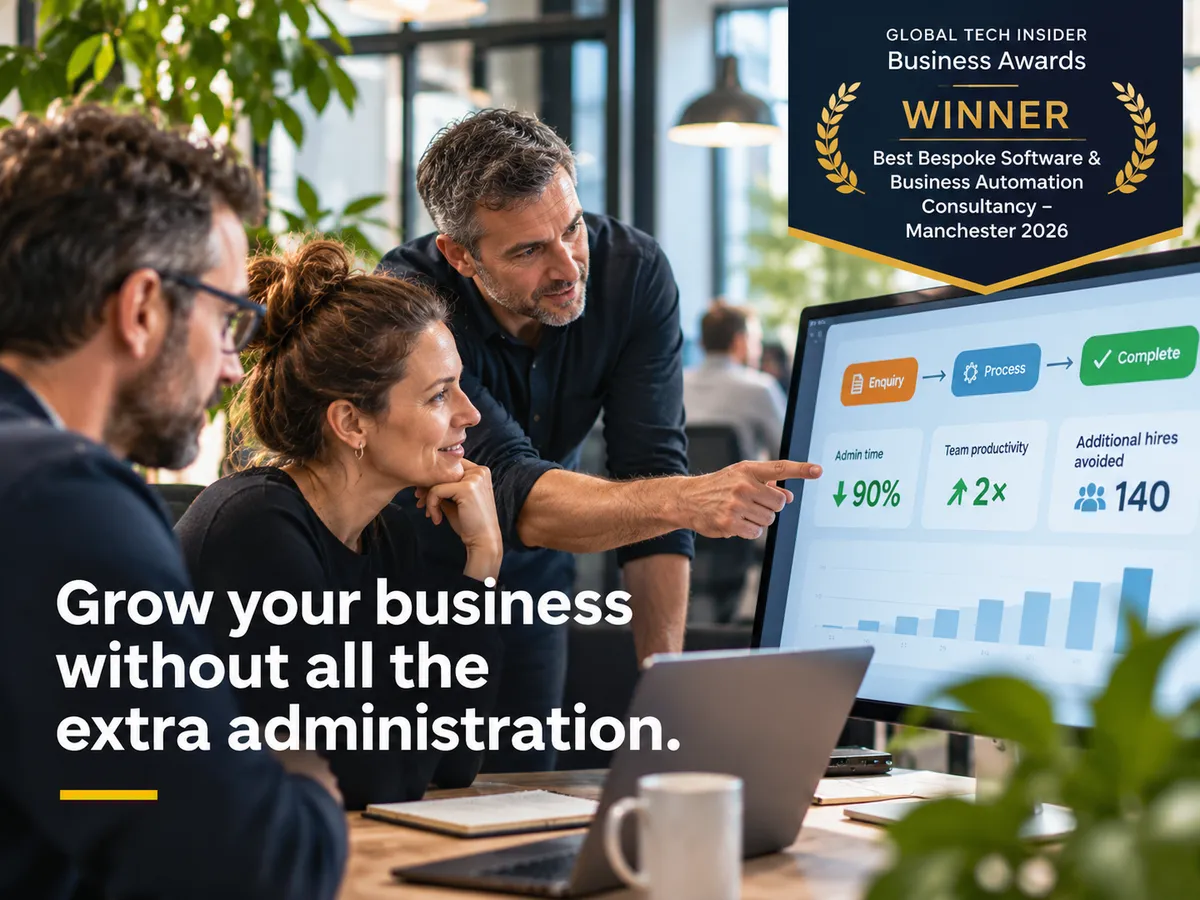
Business
What if your business could grow without all the extra administration?
We've been named Best Bespoke Software & Business Automation Consultancy – Manchester 2026 by Global Tech Insider. But the real story is what better systems can achieve: less administration, greater productivity and businesses able to grow without increasing their workforce at the same rate. One client estimates our work has saved them the need to employ 140 additional people, worth almost £10 million a year.
Tomislav Simnett
3 min read
Business
We've won a digital transformation award. Here's what really matters to us.
We've been named Digital Transformation Specialists of the Year 2026 – North West England. It's lovely recognition, but what matters more is the difference behind it: less paperwork, fewer frustrating processes and businesses able to grow without asking their people to work harder. That's what good technology should achieve.
Tomislav Simnett
4 min read

Business
Your Software Holds the Data. But Does It Know How Your Business Works?
Your software might hold all the data about your business, but does it actually know how your business works? In two recent conversations, I challenged business leaders to question something they'd always taken for granted: whether the work their people were doing needed a person to do it at all.
From unnecessary CRM administration to an entire department dependent on one employee's knowledge, both conversations revealed opportunities that went far beyond making existing tasks easier. What if our systems could understand how work happens, learn from our best people and eventually take responsibility for much of the routine work themselves?
Tomislav Simnett
8 min read