

Agile Manifesto for Software Development.
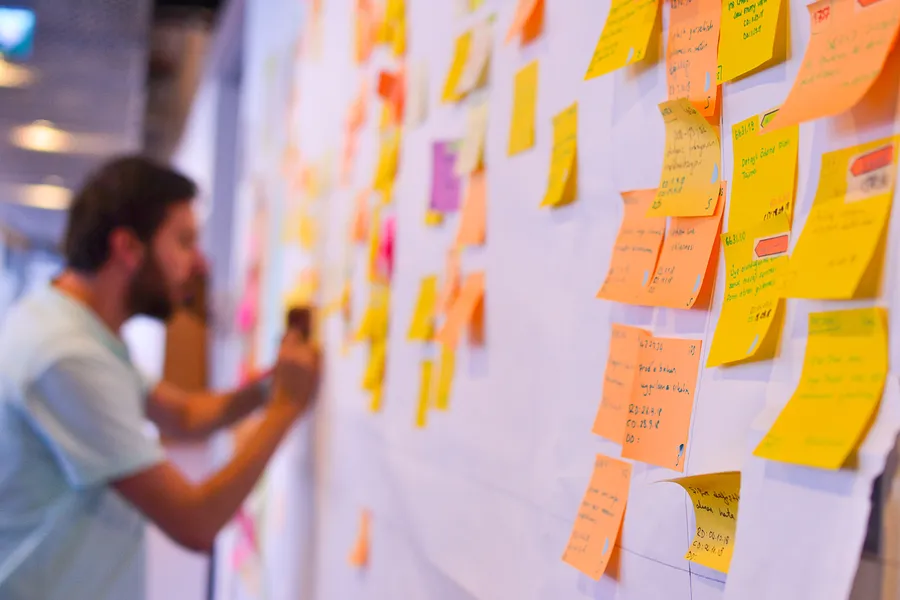
The Agile Manifesto values.
We are uncovering better ways of developing software by doing it and helping others to do it. Through this work we have come to value:
That is, while there is value in the items on the right, we value the items on the left more.
How we apply it
What this looks like at Initforthe.
We don’t treat Agile as a ceremony checklist. We use it to reduce risk, learn fast, and keep outcomes in focus.
Ship in slices
We aim for small, valuable releases so feedback arrives early and risk stays low.
Work in the open
We run one shared backlog, written decisions, and explicit trade-offs. Everyone works from the same picture, so there are no side channels and no surprise scope.
Measure outcomes
We agree success metrics early and iterate until the system makes work easier.
Design for change
We build so priorities can shift without rewriting the whole system. That means clear boundaries, sensible defaults, and room to iterate as we learn.
Co-design with stakeholders
We prototype and validate with the people who use the system, so adoption is built in.
You steer the priorities
You stay in charge of what happens next. Working increments and clear trade-offs mean your budget follows outcomes you can see, not a long plan you cannot validate until the end.
Principles behind the Agile Manifesto.
We follow these principles:
Our highest priority is to satisfy the customer through early and continuous delivery of valuable software.
Welcome changing requirements, even late in development. Agile processes harness change for the customer's competitive advantage.
Deliver working software frequently, from a couple of weeks to a couple of months, with a preference to the shorter timescale.
Business people and developers must work together daily throughout the project.
Build projects around motivated individuals. Give them the environment and support they need, and trust them to get the job done.
The most efficient and effective method of conveying information to and within a development team is face-to-face conversation.
Working software is the primary measure of progress.
Agile processes promote sustainable development. The sponsors, developers, and users should be able to maintain a constant pace indefinitely.
Continuous attention to technical excellence and good design enhances agility.
Simplicity — the art of maximizing the amount of work not done — is essential.
The best architectures, requirements, and designs emerge from self-organizing teams.
At regular intervals, the team reflects on how to become more effective, then tunes and adjusts its behavior accordingly.