

Business
Four interruptions, two lost hours and the process your people shouldn’t be driving.


Tomislav Simnett
10 min read
Businesses tend to treat low productivity, mistakes, stress and disengagement as separate problems.
Someone needs to focus more. Someone needs retraining. The team need to be more careful. Managers need to improve engagement. Perhaps the business needs another person because everybody is too busy.
Each response sounds reasonable on its own, but it ignores the environment people are working in. If the day is broken up by messages, approvals, customer questions and requests for updates, while the work itself relies on long manual processes, repeated data entry and people remembering what happens next, the outcome shouldn’t be surprising.
Routine work invites autopilot. Complex work carries a higher inherent risk of error. Interruptions break concentration, while disengagement weakens the attention people bring to the process. An error then creates rework, stress and another round of interruptions.
The business sees several people problems. Quite often, it’s one operational design problem feeding itself.
A working day doesn’t contain 7.5 productive hours
Being at work for 7.5 hours isn’t the same as producing 7.5 hours of valuable output.
People need breaks, conversations and time to think. They need to move between different types of work, help colleagues and deal with things that couldn’t have been planned. Nobody sensible should design a business on the assumption that every paid minute will be productive.
Let’s be generous and assume that somebody can produce 5.5 hours of genuinely useful work during a 7.5-hour day. That allows for normal communication, breaks and the usual movement between tasks; it would still be a good, productive day.
Now start interrupting it.
Research associated with Gloria Mark at the University of California, Irvine found that, after an interruption, it typically takes 23 minutes and 15 seconds to return to the original work. People will often complete two intervening tasks before getting back to the thing they were doing in the first place.
Four proper context-breaking interruptions therefore create roughly 93 minutes of recovery time. That doesn’t include the interruption itself, whether it’s a ten-minute call, a quick request for information, an approval that needs checking or somebody asking for an update.
Add those interruptions and you’re getting close to two hours gone.
If 5.5 productive hours was the realistic starting point, around a third of the useful working day has disappeared. The person hasn’t been idle and they probably haven’t even noticed how much time has gone; they’ve been answering questions, checking things and helping the business move.
They just haven’t been able to stay with their own work long enough to finish it.
The maths gets uncomfortable across a team
One person losing 23 minutes after an interruption feels irritating. Across a growing business, it becomes expensive.
Take a team of ten people, each dealing with four proper interruptions a day. At 23 minutes of recovery each, that’s more than 15 hours of concentration lost across the team every day.
Across roughly 230 working days, it comes to more than 3,500 hours a year. At a loaded employment cost of £35 an hour, that’s over £120,000 of paid capacity spent getting back into work people had already started.
That figure still doesn’t include the interruptions themselves.
The stupid thing is that everybody will look busy throughout it. They’re replying to messages, joining calls, searching for information, checking approvals and answering questions; nobody is sitting around doing nothing.
But the work that needs proper concentration keeps being pushed into smaller gaps. A quote takes three days rather than three hours. A specification is opened six times. A customer issue is discussed repeatedly because nobody can stay with it long enough to resolve it. Reports are started, paused, corrected and eventually completed late.
Managers look at the backlog and conclude that the team need to work faster, or that the business needs another person.
Sometimes they do. Sometimes the business has simply designed a working day in which finishing anything is unnecessarily difficult.
Routine work isn’t the same as reliable work
Interruptions become more dangerous when the underlying process already asks people to complete dozens of manual steps.
NOPSEMA, Australia’s offshore energy regulator, describes human performance as inherently unreliable. In the best observed cases, it reports error rates of around one in every 100 steps for routine, procedure-based tasks, rising to around one in ten for more complex, non-routine work. It also warns against treating human error as an isolated failure by the individual, because job design, workload, communication, procedures, culture and the wider organisation all affect reliability.
Those figures need to be understood properly.
Routine work has the lower error rate per step, but familiarity creates its own problem. NOPSEMA says skill-based errors tend to occur during highly routine activities when attention is diverted by thoughts or external factors; these include slips, forgetting to do something and losing your place in a sequence.
Complex work asks people to interpret information, weigh options and respond to situations that don’t follow a familiar route, so its underlying error risk is much higher.
Routine work invites autopilot. Complex work demands more thought. Interruptions make both more fragile.
Interrupt someone midway through a repetitive process and they may return at the wrong step. Interrupt them during a complex decision and they have to reconstruct the information, assumptions and reasoning they were holding in their head.
Either way, the business is relying on a person to remember exactly where they were and resume without losing anything.
That isn’t a particularly sensible control.
One error doesn’t remain one error
A mistake is rarely limited to the minute in which it happens.
A figure is entered incorrectly, then somebody has to find it, check the source, correct the record and work out where the wrong information has already travelled. A quote goes out with the wrong margin, so the salesperson, manager and finance team become involved. A job is scheduled using outdated information, which affects purchasing, delivery and the customer.
The error creates rework; the rework interrupts more people.
Then comes the fallout. There may be an awkward customer conversation, a delayed delivery, a credit note, a repeated report or a meeting about how the mistake happened. Managers introduce another check, another approval or another spreadsheet column to stop it happening again.
The original process becomes longer, which creates more steps, more handovers and more chances for another error.
Meanwhile, the person who made the mistake is under pressure. They’re trying to correct it while their original work backs up, other people are waiting for answers and the customer wants an explanation.
Stress rises, concentration suffers and the next task is being completed in worse conditions than the first.
The loop is fairly straightforward:
Interruption leads to lost context; lost context increases the risk of error; error creates rework and stress; the fallout creates more interruptions.
Businesses often respond with reminders to be more careful. That might help for a while, but it leaves the machinery that produced the mistake untouched.
Engagement isn’t a soft issue here
Gallup’s latest UK data makes the backdrop more serious. Only 10% of UK employees are classed as engaged at work, while 46% reported experiencing a lot of stress during the previous day.
That doesn’t mean the rest are lazy, incapable or deliberately careless. Engagement is about people’s involvement and enthusiasm for their work and workplace; it is affected by things such as clarity, having the right resources, opportunities to use strengths and whether people feel connected to what they’re doing.
Now put people into a fragmented operating environment.
Ask them to copy information between systems, chase colleagues for updates, follow long manual procedures, sit through repeated approvals and answer questions that the software should already be able to answer. Break up the day with notifications and quick calls, then hold individuals responsible when something gets missed.
You’ve combined weak engagement, high stress, interrupted attention and processes that depend heavily on human memory.
That’s a dangerous combination for any business, even when the consequences aren’t physically hazardous.
In an ordinary growing company, it shows up as margin leakage, missed revenue, delayed invoices, poor customer communication and good people leaving because the job has become an exhausting series of corrections, chasers and repeated admin.
The people cost and the commercial cost aren’t separate. People feel worse because the work is unnecessarily difficult; the business performs worse because stressed and disconnected people are being asked to compensate for badly designed systems.
Most businesses make people drive the process
Look at how work actually moves through many businesses.
A new enquiry arrives, so somebody puts it into the CRM. When the sale is agreed, they email operations and perhaps copy the information into another platform. Operations notice something’s missing, so they message sales. A manager needs to approve the margin, so the quote sits in an inbox. Finance need to know when the job’s complete, but that information lives in a spreadsheet or in somebody’s head.
The software records pieces of what happened, but people still have to drive every stage of the process.
They remember the next action. They push the work from one department to another. They copy the information, send the reminders, check whether something has been approved and tell finance when it can invoice.
Every one of those handovers creates another opportunity for interruption, delay and error.
This is often described as having several systems that “work brilliantly”. The CRM works brilliantly for sales, the operational platform works brilliantly for delivery and the accounting software works brilliantly for finance.
They just don’t work brilliantly together.
The process only works because good people keep stitching the gaps together by hand.
A well-crafted bespoke CRM drives the process
I’m using the term “CRM” because that’s the language most businesses recognise, even though what they usually need is broader than customer relationship management software.
A well-crafted bespoke CRM shouldn’t simply store customer details, record conversations and display a sales pipeline. It should drive the process that follows.
Take a quote moving through the business. The system should know what information is required before it can be issued, whether the proposed margin is within agreed limits, who needs to review a genuine exception and what happens when the customer accepts.
Once accepted, it should carry the agreed information into operations, create or update the job, assign the next action and make sure finance know when the work is ready to invoice.
People shouldn’t have to remember all of that, and they shouldn’t need to keep asking one another whether it’s happened.
The system should know where the work is, what it’s waiting for and who owns the next step. It should validate routine information, trigger normal handovers, remind people when something’s overdue and escalate genuine exceptions with the relevant context already attached.
That’s the important distinction. In most businesses, people drive the process and the software records bits of it. In a properly designed system, the software drives the ordinary process and people deal with the decisions, exceptions and customer situations that genuinely need judgement.
That doesn’t mean forcing every job through one rigid route. Real businesses have variations, unusual requests and customers who don’t behave according to a tidy process diagram. A good bespoke CRM needs to support that reality; it should handle the normal route and make exceptions obvious, rather than making every job depend on someone remembering what to do.
The system should preserve context
A well-designed bespoke CRM also reduces the cost of interruption by preserving the state of the work.
If somebody is pulled into a call halfway through preparing a quote, they shouldn’t need to reconstruct everything from email threads, handwritten notes and memory when they return. The system should show what’s already happened, which information is present, what’s missing and what needs doing next.
If an approval is required, the approver should receive the relevant information together, rather than asking three follow-up questions and interrupting several more people.
If a customer wants an update, the answer should be visible without somebody messaging operations, waiting for a response and then translating it back to the customer.
A well-crafted system doesn’t stop people communicating; it stops them having to communicate merely to locate information and move work forwards.
That’s how better systems protect attention. They don’t tell people to concentrate harder, they remove the unnecessary questions, repeated checking and need to carry unfinished processes around in their heads.
AI and automation should support the flow
AI and automation can strengthen this enormously, provided the underlying process makes sense.
They can extract information from customer documents, summarise conversations, check entries against agreed rules, identify unusual values and prepare the context needed for a decision. They can route work, update records and make sure the next person receives what they need without somebody manually copying it across.
But AI shouldn’t become another separate tool that people have to check, prompt and reconcile with everything else.
It should sit inside the flow of work.
The aim isn’t to replace judgement. It’s to stop wasting judgement on administration, repeated checking and the movement of information from one place to another.
Good people should be spending more time solving problems, helping customers and dealing with the situations that genuinely need human thought; they shouldn’t be acting as the workflow engine while the systems watch.
Start with one real process
You don’t need to measure every interruption in the business before doing anything. Most companies won’t have perfect data, and waiting for it can become another excuse to leave the problem alone.
Pick one process people regularly complain about. It might be quoting, onboarding a customer, scheduling work, processing an order or getting a completed job invoiced.
Follow ten real examples and look at what actually happens. How many manual steps are involved? How often is information copied? How many people touch it? How many questions are asked? Where does the work stop? How many times is it reopened? What errors occur, and how many people become involved in putting them right?
Then ask the more important question:
Is the system driving this process, or are the people driving it?
If the work only moves because somebody remembers to update a spreadsheet, send an email, chase an approval or tell the next department, then you haven’t really got a system managing the process. You’ve got software recording parts of it while good people hold the rest together.
Put some numbers against that effort. Even rough maths is better than pretending each interruption only costs the two minutes spent answering it. Our operational friction calculator exists for exactly that reason, turning small, tolerated bits of effort into hours, salary, capacity and margin.
The answer isn’t to ban Teams, lock people away or demand 7.5 hours of perfect concentration. Businesses need communication, flexibility and people helping one another.
The goal is to remove the questions, checks and switches that never needed to exist.
A properly designed bespoke CRM should make the current position visible, carry information forwards, tell people what genuinely needs their attention and move routine work without being pushed at every stage.
Once the system drives the process, people can focus on customers, decisions and valuable work, rather than copying, checking, chasing and remembering what the software should already know.
Because when interruption, error, stress and disengagement start feeding one another, the business doesn’t just lose a few minutes. It loses capacity, confidence and margin, then pays more people to keep the same fragile process moving.
Clear goals, slow team? We fix the bit in between.
How much capacity is your business leaving behind?
Use the calculator to estimate what slow processes, manual work and disconnected systems could really be costing you.
More posts.
View all
Tech
AI can write the code. Your business still needs an engineer
AI can now write a lot of the code we used to pay developers to write. That doesn’t make software engineering irrelevant. It makes the bit that was always more important much harder to ignore: understanding what should be built in the first place.
Vibe coding can turn your assumptions into working software incredibly quickly. But if the assumption is wrong, you’ve simply built the wrong thing faster. Good engineering starts before the app, CRM or automation. It starts by understanding how the business actually works, where people add judgement, and which parts of the process shouldn’t exist at all.
Tomislav Simnett
11 min read

Business
The approval takes five minutes. The waiting costs far more.
A five-minute approval can leave work waiting for days. Once a quote, purchase, job or invoice misses its slot, the delay spreads into the rest of the process.
People switch tasks, schedules move, customers wait and cash arrives later. The decision itself may be quick, but the queue around it can cost far more than anyone realises.
Tomislav Simnett
9 min read
Business
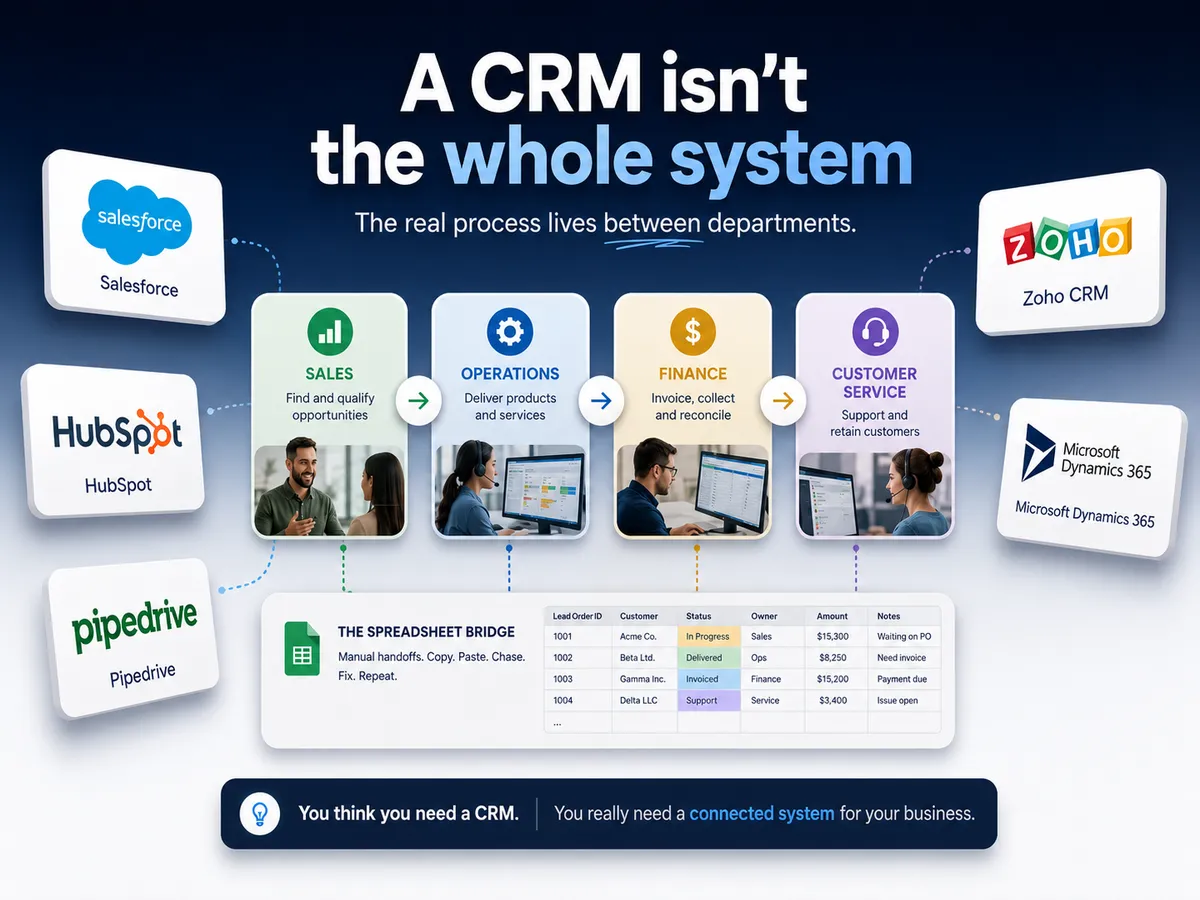
You probably don’t need a CRM; you need the work to flow properly.
Most growing businesses think they need a CRM, but the real problem usually sits between departments.
When sales, operations and finance all rely on different systems, spreadsheets and good people end up holding the process together by hand.
When sales, operations and finance all rely on different systems, spreadsheets and good people end up holding the process together by hand.
Tomislav Simnett
6 min read