

Business
Don't be afraid to ask 'Why' in your business.
It's the main question we ask our clients, so that they get the best from us


Tomislav Simnett
2 min read
The word 'Why' is part of a group of interrogative words that ask a question:
Where? - What? - How? - When? - Who?
Why? - Which? - Whom? - Whose?
In business, 'Why' has to be the most powerful one of them all since most of the other interrogative words produce a relatively simple answer:
- Where is... Answered with a simple location statement
- What is... Answered with a description
- When is... Answered with a time reference
- Who is... Answered with a name
... you get my point.
Perhaps the only other word able to challenge 'Why' is 'How'; although it could be argued that 'How' can be answered either correctly or incorrectly, depending on someone's point of view.
Both words elicit a conversation; a discussion and often an argument, but assuming the conversation is carried out amicably, you should end up with an agreement.
At initforthe, we ask our clients 'why' a lot. We want to make sure they get the best value from the work we do, so we need to understand the need for what is being asked for.
So don't be afraid to ask 'why' - because:
It improves stuff
Of course, this is the reason we spend much of our time asking this question. Why is something done the way it is? The most common reply we hear is something along the lines of "…well, that’s how we’ve always done it.” That one phrase alone is enough to stagnate any company, if not be the complete ruin of them.
Don't be afraid to ask 'why' you do certain processes within your business. And if the answer is unclear, or if it's not done for the right reasons or provides a commercial benefit to you - then change it.
It encourages open-mindedness
In many areas of knowledge we are encouraged to never stop asking questions. Can you imagine if Newton had stopped asking 'why' before developing his theory of gravity? What would the minds at CERN be doing if they weren't constantly asking why?
Simply by asking the question, you are showing a level of open-mindedness and the willingness to listen to the thoughts of others. Whilst they may not convince you to change a belief, you are giving them the chance.
It can change your beliefs
This does, of course, assume that the debate is amicable. That doesn't mean the conversation can't become heated and passionate, but you have to be prepared to listen to the point of view of others and allow them to explain themselves fully. Going back to old science examples, I'm fairly certain lots of people asked 'why' at the point they were challenged on whether our tiny blue planet was the centre of everything or was indeed flat.
Question for you
When was the last time you challenged a process in your business?
How much capacity is your business leaving behind?
Use the calculator to estimate what slow processes, manual work and disconnected systems could really be costing you.
More posts.
View all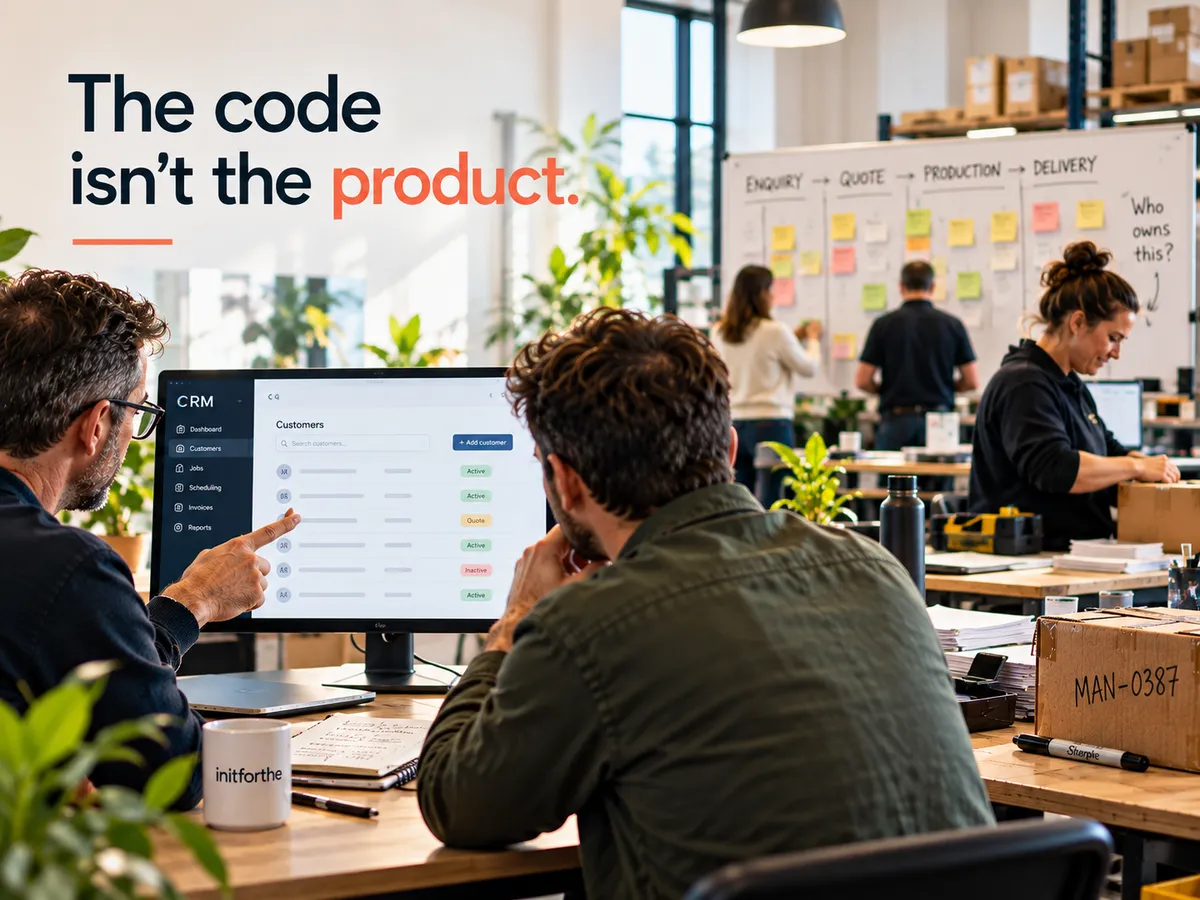
Tech
AI can write the code. Your business still needs an engineer
AI can now write a lot of the code we used to pay developers to write. That doesn’t make software engineering irrelevant. It makes the bit that was always more important much harder to ignore: understanding what should be built in the first place.
Vibe coding can turn your assumptions into working software incredibly quickly. But if the assumption is wrong, you’ve simply built the wrong thing faster. Good engineering starts before the app, CRM or automation. It starts by understanding how the business actually works, where people add judgement, and which parts of the process shouldn’t exist at all.
Tomislav Simnett
11 min read

Business
Four interruptions, two lost hours and the process your people shouldn’t be driving
Four interruptions can wipe nearly two hours from the useful part of a working day, and that’s before you count the interruption itself. Add long manual processes, routine human error, rework and stress, and you get a working environment where good people spend too much time recovering, correcting and chasing.
The answer isn’t to tell people to focus harder. It’s to design a better system, one that drives the process, preserves context, moves routine work automatically and only interrupts people when their judgement is genuinely needed.
Tomislav Simnett
10 min read

Business
The approval takes five minutes. The waiting costs far more.
A five-minute approval can leave work waiting for days. Once a quote, purchase, job or invoice misses its slot, the delay spreads into the rest of the process.
People switch tasks, schedules move, customers wait and cash arrives later. The decision itself may be quick, but the queue around it can cost far more than anyone realises.
Tomislav Simnett
9 min read