

Business
Are you a Dinosaur?.
"Dinosaurs had their shot, and nature selected them for extinction." - Dr. Ian Malcolm, Jurassic Park. 1993


Andrew Carson
3 min read
When you think of that question you will either have a picture in your head of the large, toothy reptile species long extinct or something that is outdated or obsolete due to failure to adapt to changing circumstance. Maybe you don’t see yourself falling into either description but you should ask what are you doing to survive the technical evolution?
Back in their era, dinosaurs existed for upwards of 165 years. Things were simple and evolution was slow. In today’s tech savvy world evolution can pass you by in as little as a year and the reason is because businesses want to be ahead of evolution. The term dinosaur relates more to business practice now than it does to our lost lizard inhabitants.
Lost Time
One of the most common practices associated with the ‘dinosaur’ tag is mass paperwork and spreadsheet use in the workplace. “We have always done it this way” is the battle cry of the dying breed which may as well be spelling out “We are losing time and money due to our antiquated systems and methods.”
The more forward-thinking directors among us are looking at what their employees should be doing and could be doing if they were not constantly correcting figures on an excel spreadsheet.
With more and more companies moving into the realm of RPA (Robotic Process Automation) which can handle a business’s mundane and repetitive tasks, statistics show that these companies are making more money and have increased productivity, without adding to the staff headcount.
Moving Ahead in the World
So why are dinosaurs afraid of evolving like others? Its fair to assume that most directors start up their businesses because they feel they were ahead of the herd or had something unique to offer over the businesses of the time, so why do they now assume the ideology of “If it ain’t broke don’t fix it?” Why is the fear of change stronger than the fear of becoming obsolete and going under like a T-Rex in a tar pit?
Is it an overall fear of the unknown? Is it down to misconceptions, confusion or the thought of spending money on something you have trouble understanding? Below we have answered some of the most common concerns of business owners when confronted with the possibility of automating their processes.
We’ve had the same staff and don’t want to lose them!
Automation technology is not a system for terminating the human element. In fact, it is designed to strengthen the human element by making it more productive and eliminating the dreaded human errors which leave a client dissatisfied with the company. Employees don’t have 101 jobs hanging over their head as in most cases the jobs are done within seconds. Pretty much any staff member would be relieved to have that kind of system in place, and ask yourself: Why would you have an employee on the books just simply to handle those jobs that can take all day instead of a system that has it done in seconds?
We don’t have the money to implement such a system!
You also don’t have the money you would be generating from having automation in place. Warren Buffet once stated “If you don’t find a way to make money while you sleep, you will work until you die.” Such a system works 24/7 365 days a year with no days off and no holidays. By now you should have a figure in your head of what that saves. Once you get your head around the fact that this is an investment, not an expense, you start to see the real benefit of what can be achieved.
We are not very technical and wouldn’t know where to start.
Any automation company worth their salt designs your system with you and your employees in mind when it comes to use. If it comes with an instruction manual then its too complicated. The point of such a system is something that you can rely on and stop constantly checking to see if something is done properly and focus on avenues for your business you have not been previously able to direct towards.
So why not?
Of course here we are using comparisons to a species that ran out of time, but companies suffer from not utilising the time they can have to focus on their evolution.
Automation is found as a logical step to achieve maximum operating capacity and eliminate repetitive patterns in your daily process.
What can you do next?
The first step for any business should be to look into their weekly routines and consider or ask the question of what could be automated to push them ahead productively.
Data processing, invoicing, email responses and updating records use up a considerable amount of time and are prime areas for automating. These alone can allow your business to grow by an order of magnitude without hiring any extra people.
How much capacity is your business leaving behind?
Use the calculator to estimate what slow processes, manual work and disconnected systems could really be costing you.
More posts.
View all
Business
What if your business could grow without all the extra administration?
We've been named Best Bespoke Software & Business Automation Consultancy – Manchester 2026 by Global Tech Insider. But the real story is what better systems can achieve: less administration, greater productivity and businesses able to grow without increasing their workforce at the same rate. One client estimates our work has saved them the need to employ 140 additional people, worth almost £10 million a year.

Tomislav Simnett
3 min read
Business
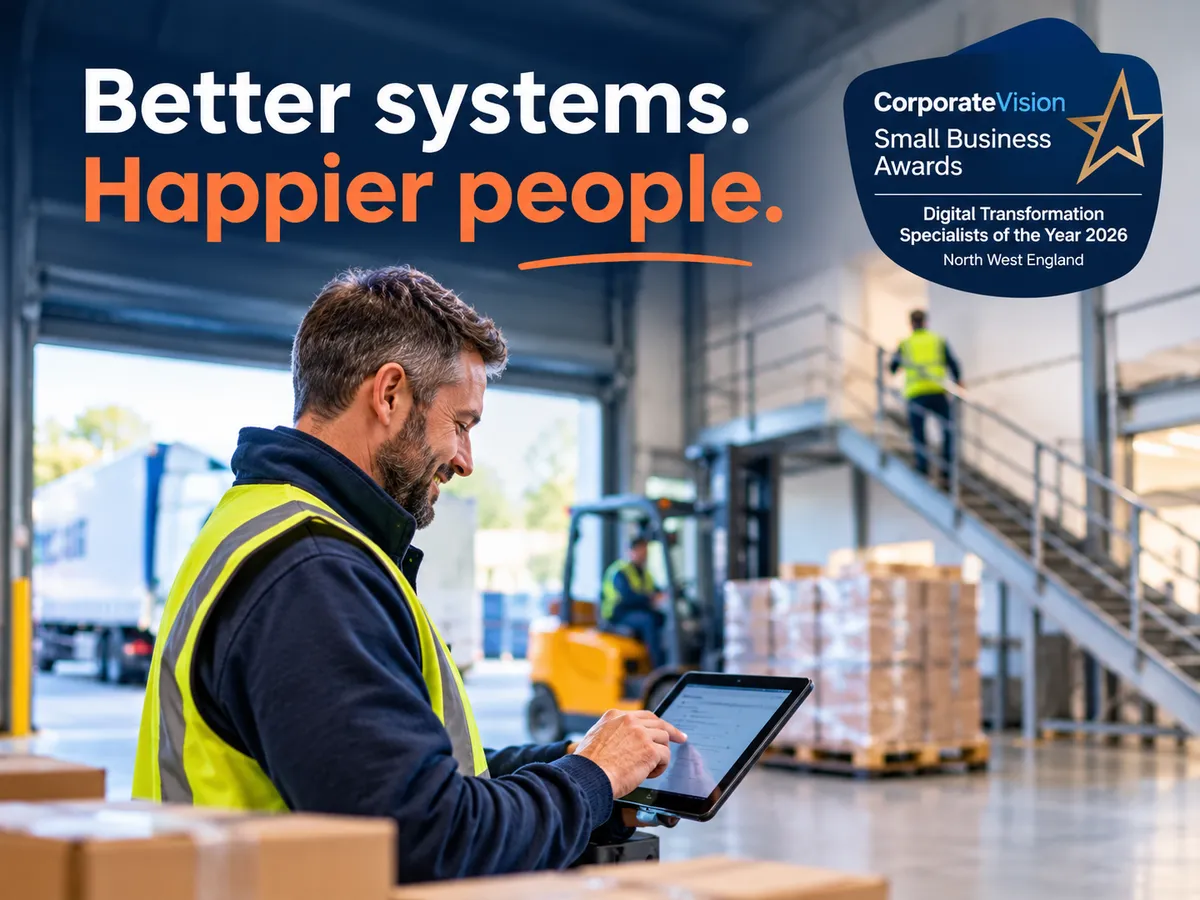
We've won a digital transformation award. Here's what really matters to us.
We've been named Digital Transformation Specialists of the Year 2026 – North West England. It's lovely recognition, but what matters more is the difference behind it: less paperwork, fewer frustrating processes and businesses able to grow without asking their people to work harder. That's what good technology should achieve.
Tomislav Simnett
4 min read

Business
Your Software Holds the Data. But Does It Know How Your Business Works?
Your software might hold all the data about your business, but does it actually know how your business works? In two recent conversations, I challenged business leaders to question something they'd always taken for granted: whether the work their people were doing needed a person to do it at all.
From unnecessary CRM administration to an entire department dependent on one employee's knowledge, both conversations revealed opportunities that went far beyond making existing tasks easier. What if our systems could understand how work happens, learn from our best people and eventually take responsibility for much of the routine work themselves?
Tomislav Simnett
8 min read